



Managing inventory across Amazon, Shopify, and wholesale channels introduces operational complexity that many growing businesses underestimate.
Each additional sales channel expands revenue opportunity, but it also increases synchronization risk. When the same SKU exists simultaneously on Amazon, Shopify, and wholesale accounts, inventory must be governed centrally. Without structural control, overselling, reconciliation gaps, and financial inconsistencies become inevitable.
In 2026, sustainable multi-channel growth depends less on monitoring dashboards and more on designing the correct inventory architecture.
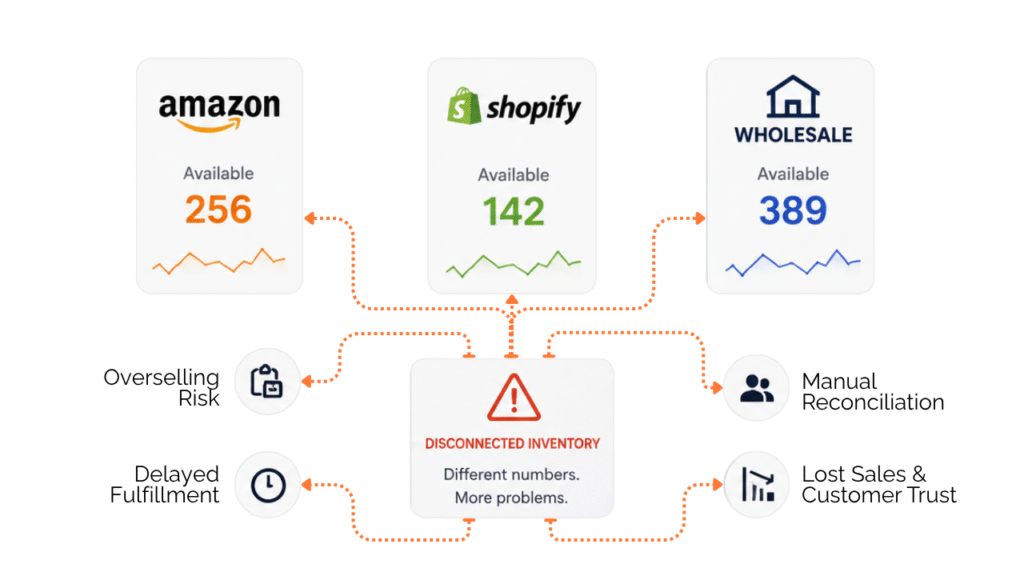
Why Multi-Channel Inventory Break
Businesses often expand gradually. They launch on Amazon, add Shopify, and later introduce wholesale accounts. While each channel may function independently, problems arise when they are not structurally connected:
- Delayed stock updates between platforms
- Inconsistent SKU naming
- Mixing Amazon FBA and in-house quantities
- Manual spreadsheet allocation for wholesale
- Adjustments made in multiple systems
These issues are not caused by a lack of effort. They are caused by fragmentation. When each channel deducts inventory independently, discrepancies accumulate over time.
The Foundational Decision: Where Inventory Is Controlled
Every multi-channel business must answer one fundamental question: Where does inventory live?
If Amazon deducts inventory on its own, Shopify deducts separately, and wholesale allocations are managed manually, inventory balances will inevitably diverge.
The correct structure separates responsibilities:
- A centralized inventory control system
- Marketplace and channel integrations
- Financial synchronization
Inventory should be deducted from one system only. All other platforms should reflect that deduction. This single-source-of-truth model eliminates most overselling risk.
Understanding Channel Complexity
Multi-channel inventory complexity arises because each sales channel follows different fulfillment logic and deduction timing rules, requiring structured alignment within a centralized system.
Amazon: FBA and FBM Separation
Amazon inventory may exist in multiple fulfillment environments, i.e., in Amazon FBA warehouses or within your own facility for FBM orders. These inventory pools must be represented separately.
FBA quantities should be treated as a distinct warehouse location within the centralized system. Blending FBA and in-house stock creates reconciliation errors and distorted availability across channels.
Shopify: Immediate Deduction Sensitivity
Shopify deducts inventory as soon as an order is placed. When Shopify inventory is not synchronized with Amazon and wholesale allocations in real time, overselling becomes likely.
Shared SKUs require centralized deduction to maintain consistency across platforms.
Wholesale: Allocation Discipline
Wholesale orders often involve larger quantities and negotiated fulfillment timelines. If wholesale inventory is not reserved or deducted at confirmation, available inventory becomes overstated on Amazon and Shopify.
Wholesale allocations must be reflected immediately in available stock calculations to prevent cross-channel conflicts.
How to Design a Centralized Multi-Channel Structure
A centralized multi-channel structure is built by aligning inventory governance, product data, location logic, and order flow into a single controlled system.
Centralized Inventory Governance
Inventory quantities, SKU records, warehouse locations, and cost data should be governed by a dedicated inventory management system rather than marketplace dashboards.
Marketplaces are sales channels, not inventory control systems. All operational movement — receiving, transfers, sales, and adjustments — should occur within a centralized platform.
SKU Standardization
Before integrating channels, SKU consistency must be enforced. SKU inconsistency is a hidden driver of multi-channel mismatch. Each SKU should correspond to a single product definition. Naming conventions should remain uniform across Amazon, Shopify, wholesale portals, and accounting systems.
Location-Based Inventory Separation
Separate the inventory based on location:
- Primary warehouse
- Amazon FBA warehouse
- Retail or showroom locations
- Wholesale reserved inventory
Maintaining clear location-level quantities improves reconciliation and prevents shared-pool confusion.
Centralized Order Flow Before Deduction
Orders from Amazon, Shopify, and wholesale accounts should flow into one centralized inventory system before stock deduction occurs.
C2W Inventory integrates directly with Shopify and connects Amazon and additional marketplaces through Veeqo, an Amazon-owned ecommerce software platform. This structure allows orders from Amazon, Shopify, and other marketplaces to flow into one centralized inventory system, ensuring accurate deduction and unified stock visibility across all sales channels.
The operational sequence should follow this model:
- Sales Channels
- Connector Layer
- Central Inventory Deduction
- Financial Synchronization
When inventory deduction follows a centralized sequence, businesses gain consistent stock visibility, reduce synchronization conflicts, and create a more scalable multi-channel fulfillment structure.
Financial Synchronization Without Operational Conflict
Operational inventory control and accounting serve different purposes. Once inventory is deducted centrally, the summarized financial impact should synchronize with accounting platforms such as QuickBooks Online.
Inventory platforms such as C2W Inventory operate as the warehouse control layer while synchronizing summarized financial data into accounting systems. Clear separation between operational control and financial reporting strengthens both accuracy and audit defensibility.
Strengthening Multi-Channel Inventory Stability and Control
As multi-channel operations expand, inventory stability depends on how effectively systems, locations, and order flows are coordinated.
Strengthening structural control reduces overselling risk, improves synchronization accuracy, and creates a more scalable fulfillment environment. Let’s take a closer look at the key structural factors that determine how reliably inventory performs across channels.
Overselling Is a Structural Problem
Overselling is not caused by isolated errors but by weaknesses in inventory architecture. It typically emerges when structural controls are not centralized across channels.
- Inventory deductions occur across multiple disconnected systems
- Synchronization delays create timing mismatches between platforms
- Wholesale allocations are not reserved at the correct stage
- FBA inventory is inconsistently represented within the system
- Manual overrides disrupt automated stock logic
Multi-channel businesses operating across two or more sales platforms commonly experience 1–3% overselling incidents. At its core, overselling reflects fragmented inventory governance rather than marketplace-specific issues. A centralized deduction structure eliminates these systemic gaps and improves overall stability.
Coordinating FBA and In-House Inventory
FBA and in-house stock must operate as distinct but connected inventory locations within a unified system. Failing to separate them creates structural reporting and availability conflicts.
FBA inventory should be tracked independently as a dedicated warehouse location, with inbound and outbound movements recorded separately. FBA orders must be deducted only from that location, followed by regular reconciliation against Amazon reports.
When FBA and in-house stock are properly isolated, inventory visibility remains accurate and structurally consistent across channels.
Wholesale Allocation Control
Wholesale inventory requires controlled allocation logic within the broader inventory structure. Stock should be reserved or deducted at the point of order confirmation, not shipment, to prevent artificial inflation of available inventory.
Without early allocation control, wholesale orders distort stock visibility across Amazon and Shopify channels. Treating wholesale as a structured inventory layer ensures accurate availability and prevents cross-channel conflicts.
Automation as a Stability Layer
Multi-channel inventory stability depends heavily on automation that eliminates manual intervention gaps. At scale, manual reconciliation introduces delays and inconsistencies that weaken structural integrity.
Modern inventory systems unify marketplace connectors, multi-location tracking, barcode workflows, and accounting synchronization into a single operational layer. This reduces timing gaps and ensures consistent stock movement across all channels.
Warehouse automation does not just improve efficiency, but it also stabilizes inventory architecture by enforcing consistency in real time.
Warning Signs of Structural Weakness
Structural weaknesses in inventory systems become visible through recurring operational symptoms that indicate breakdowns in governance.
- Frequent overselling incidents across channels
- Persistent inventory mismatches between platforms
- Negative inventory balances appearing in reports
- Long or repeated reconciliation cycles
- Discrepancies in FBA quantity reporting
- Increased reliance on manual spreadsheet overrides
These signals indicate architectural fragmentation rather than isolated operational errors, and they typically worsen as multi-channel complexity increases.
Wrapping Up: Multi-Channel Inventory Management Is a Leadership Decision
Managing inventory across Amazon, Shopify, and wholesale requires deliberate system design.
The critical decisions involve where inventory is governed, where stock deductions occur, how locations are structured, how channels integrate, and how financial impact synchronizes.
When inventory control is centralized and structured, growth scales predictably. When channels operate independently, growth amplifies instability.
In 2026, sustainable multi-channel expansion belongs to businesses that design their inventory architecture deliberately.
Frequently Asked Questions
Can Amazon and Shopify share the same inventory pool?
Yes, provided both channels deduct inventory from a centralized system. Independent deductions increase overselling risk.
How should Amazon FBA inventory be managed?
FBA should be represented as a separate warehouse location and reconciled regularly against Amazon reports.
Should wholesale inventory be reserved immediately?
Yes. Wholesale allocations should deduct or reserve stock upon confirmation to prevent cross-channel overselling.
What causes multi-channel inventory mismatches?
Delayed synchronization, inconsistent SKUs, fragmented systems, and manual overrides are the most common causes.
Is centralized inventory control necessary for multi-channel selling?
As sales channels increase, centralized inventory governance becomes essential to maintain operational accuracy and financial reliability.