



What is a GTIN?
A GTIN (Global Trade Item Number) is a unique numeric identifier used to represent a specific product or product variation.
Created under the GS1 global standard, GTINs ensure that every item, regardless of where it is made, sold, or shipped, can be recognized worldwide.
Each product variation, such as size, color, or packaging type, receives its own GTIN. Businesses can generate GTIN values for internal use or assign official GS1 GTINs purchased through GS1, ensuring every product variation is uniquely identifiable. For example:
- A single 500 ml shampoo bottle has one GTIN.
- A 12-pack case of that same shampoo has another GTIN for the case level.
A GTIN represents data, while a barcode is the visual symbol that encodes that data for scanners to read. When you look at a product’s barcode, the string of numbers printed beneath the bars is the GTIN.
If you would like to understand more about the differences between barcode types, read our related guide “EAN vs. UPC: The Complete Barcode Comparison Guide.”
GTIN Structures
GTINs can have 8, 12, 13, or 14 digits depending on where and how the product is used.
All formats follow the same GS1 standard and are intended for global use.
Type | Length | Common Use | Barcode Format | Notes |
GTIN-8 | 8 digits | Small items, usually outside North America | EAN-8 | Used when packaging space is limited |
GTIN-12 | 12 digits | North America retail POS | UPC-A | Synonymous with UPC |
GTIN-13 | 13 digits | Global retail POS | EAN-13 | Synonymous with EAN |
GTIN-14 | 14 digits | Cases, pallets, or inner packs | ITF-14 / GS1-128 | Not used at retail checkout |
Each structure connects individual units, boxes, and pallets, allowing complete product traceability throughout the supply chain.
How GTINs Work in Practice
GTINs tie together every stage of a product’s journey.
- Manufacturers assign GTINs when products are created.
- Warehouses use them for receiving, storage, and order picking.
- Retailers and marketplaces rely on them to list, verify, and sell items accurately.
You can assign or import a GTIN for every item in your database. When you print GTIN barcode labels, the barcode, such as UPC, EAN, or GS1-128, is automatically generated from that GTIN.
During receiving, picking, or sales, scanning that barcode retrieves the correct product record instantly, preventing costly mix-ups and saving time. In addition, GTINs also allow each level of packaging, such as units, boxes, and cases, to be tracked individually for better visibility and control.
Why GTINs Matter
Global Trade Item Numbers (GTINs) might seem like small details, but they have a significant impact on business operations.
Here are a few of the key benefits:
Consistency across platforms:
They ensure your products match correctly across Amazon, Shopify, distributors, and retail systems.
Error prevention:
Each GTIN is unique, eliminating duplicate SKUs and mismatched data.
Traceability:
They connect products across multiple packaging levels for clear audit trails.
Automation:
Systems can scan and update data instantly, replacing manual entry.
Compliance:
Many retailers and marketplaces require GS1-verified GTINs for listing approval.
GTIN vs. Barcode: What Is the Difference?
It is common to hear “GTIN” and “barcode” used interchangeably, but they are not exactly the same.
A GTIN is the number that identifies the product, while a barcode is the image that represents that number and can be scanned.
When you buy GTINs from GS1, you are purchasing those identification numbers, not the barcode itself. Once you have a GTIN, you can encode it into different barcode GTIN types, such as UPC or EAN, depending on where your products are sold.
Instead of thinking of “GTIN vs. UPC,” it is more accurate to think of it as:
- GTIN = the identification number
- UPC or EAN = the barcode that represents it visually
How Barcodes Streamline Your Daily Workflow
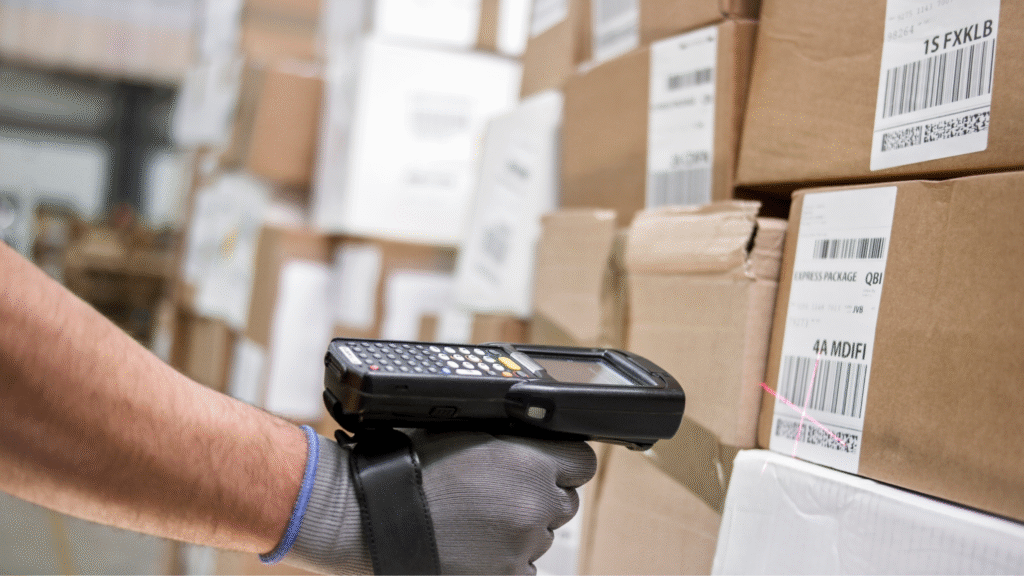
Once Global Trade Item Numbers (GTINs) are assigned to your products, barcodes turn those numbers into a practical tool you can use across your daily operations. They make identifying, tracking, and updating products faster and more accurate, forming the foundation of effective GTIN management and minimizing errors throughout your workflow.
Once Global Trade Item Numbers (GTINs) are assigned to your products, barcodes turn those numbers into a practical tool you can use across your daily operations. They make identifying, tracking, and updating products faster and more accurate, forming the foundation of effective GTIN management and minimizing errors throughout your workflow.

In an organized system, scanning a barcode instantly retrieves the correct product record. Your team can view item details, check stock levels, create or fulfill orders, and record movements without typing a single number. Every scan updates your inventory in real time, keeping your inventory barcode system accurate and ensuring that your data always reflects what is happening on the floor.
This seamless connection between GTIN in inventory workflows, barcodes, and product data allows your entire operation, from receiving to picking to sales, to work from the same accurate source of information. It brings structure, visibility, and speed to every process.
Modern platforms such as C2W Inventory make this even easier by connecting GTINs, barcodes, and item data in one unified system. This allows businesses to label, scan, and track inventory effortlessly while optimizing their overall barcode workflow across multiple warehouses and sales channels.
When GTINs and barcodes work together, your entire workflow becomes faster, more accurate, and easier to manage.
Do You Need to Buy GTINs?
Whether you need to purchase GTINs depends on where and how you sell your products.
Scenario | Need to Buy from GS1? | Notes |
Selling on Amazon, Walmart, or retail stores | Yes | GTINs must be GS1-registered and tied to your company prefix |
Selling only on your own website or internally | No | You can create internal GTINs for scanning and reporting |
Custom, handmade, or private-label products | No | You can apply for a GTIN exemption if required by the marketplace |
If you sell on Amazon or major retailers, you must purchase GSI GTIN codes so they are registered under your company prefix.
If you sell exclusively on your website or use them for internal tracking, you can create your own GTINs as long as they are unique within your system.
For handmade, custom, or private-label products, you can request a GTIN exemption from marketplaces that require them.
Related Reading: “EAN vs. UPC: The Complete Barcode Comparison Guide”