


What Has Changed in 2026
Historically, RFID adoption was slowed by high tag costs, expensive infrastructure, and complex integration projects. It was often treated as an enterprise level investment.
Today, passive UHF RFID tags can cost just a few cents when purchased in volume. Reader hardware is more affordable, and modern inventory systems are better equipped to support automation without requiring a complete software overhaul.
As a result, the discussion has shifted. Instead of asking whether RFID is too expensive, warehouses are asking whether it can reduce labor and improve accuracy enough to justify investment.
Barcode vs RFID in Daily Operations
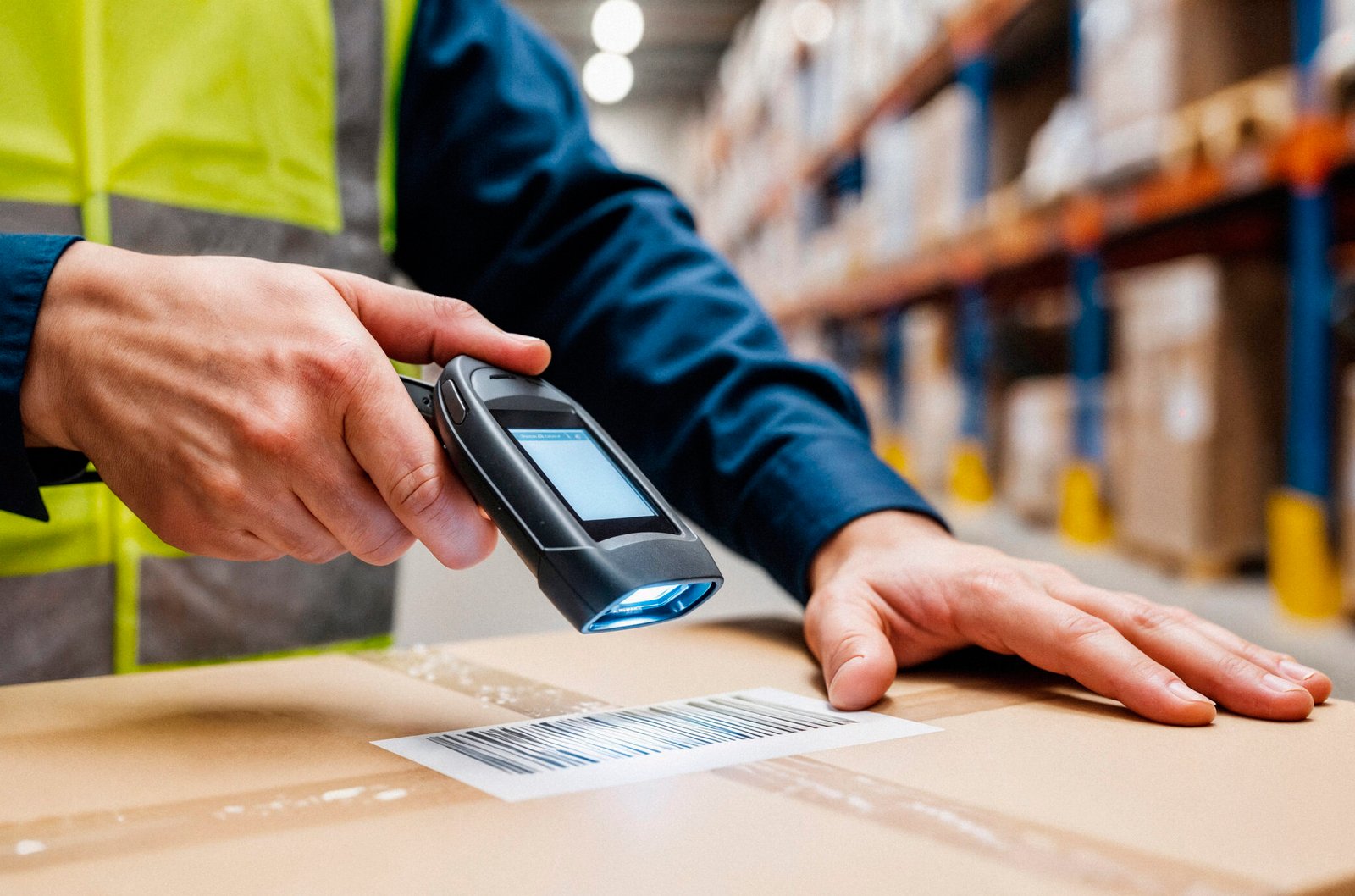
Barcode inventory systems rely on line-of-sight scanning. Every item must be individually scanned. Receiving teams process cartons one by one. Pickers confirm each SKU manually. Cycle counts require physical scanning of every location.
Barcodes remain reliable and cost-effective. For small and mid-sized warehouses, they offer strong control with minimal infrastructure cost. However, labor scales directly with volume. As SKU counts and shipment sizes increase, manual scanning time increases as well.
Read more: A Comparison of 1D vs 2D Barcodes Every Business Should Know
RFID changes this structure. Multiple tagged items can be read simultaneously without line of sight. Entire cartons or pallets can be captured during receiving in seconds. Cycle counting can be performed by walking an aisle rather than scanning each bin.
The difference is not incremental efficiency. It alters how labor is allocated.
When RFID Delivers Real ROI
RFID is most effective in high SKU, high volume environments. Apparel, footwear, electronics, and serialized goods operations often see the strongest benefit because complexity amplifies manual workload. In fact, RFID-enabled environments regularly report 95%–99% inventory accuracy.
Labor cost pressure accelerates return. If warehouse wages are rising or overtime is frequent, reducing receiving and counting hours directly lowers operating expenses.
Inventory accuracy also plays a critical role. If teams regularly investigate discrepancies or spend excessive time searching for misplaced inventory, automation reduces those hidden costs.
In these environments, RFID becomes a financial strategy rather than a technology experiment.
A Practical Cost Scenario
Consider a warehouse managing 20,000 SKUs and receiving 10,000 units weekly. If receiving requires approximately 40 labor hours per week at a fully loaded wage of $25 per hour, annual receiving labor totals around $52,000.
If RFID reduces receiving labor by 50 percent, annual savings approach $26,000. With infrastructure and tag investment factored in, payback may occur within two years. In larger operations, ROI accelerates further.
This does not include improved fulfillment speed, lower error rates, or reduced shrinkage, which add additional value.
When Barcode Still Makes Sense
RFID is not automatically the right decision for every warehouse.
Smaller operations, limited SKU environments, or businesses operating on tight margins may not generate enough labor savings to justify infrastructure investment.
In many cases, improving barcode discipline and ensuring real-time inventory visibility already delivers substantial gains. Standardized receiving workflows and accurate transaction tracking often solve more operational issues than advanced hardware alone.
Technology strengthens good processes. It does not compensate for the weak ones.
Building the Right Foundation
Before considering RFID, warehouses should confirm that SKU data is structured, locations are clearly defined, and inventory updates are in real time across locations.
Businesses using platforms such as C2W Inventory often begin by strengthening barcode workflows and operational visibility. As complexity grows, the system is structured to support more advanced automation, including RFID integration, without requiring a full system replacement.
That flexibility allows automation decisions to be strategic rather than reactive.
The Strategic Question
RFID is no longer futuristic. In the right environment, it is financially practical.
If your warehouse operates with high SKU complexity, rising labor costs, and manual receiving bottlenecks, 2026 may be the right time to switch.
If your operation still has opportunities to improve process control and visibility, strengthening those fundamentals may produce a faster return.
The key is alignment between operational complexity and technology investment. That alignment is what turns automation into a measurable advantage.
FAQs
What is the main difference between RFID and barcode systems?
Barcodes require line-of-sight scanning and must be scanned one item at a time. RFID (Radio Frequency Identification) uses radio waves to read multiple tagged items simultaneously without direct visibility. This allows cartons, pallets, or entire shelves to be captured in seconds instead of minutes.
Does RFID eliminate the need for barcode scanning entirely?
Not always. Many warehouses operate hybrid systems where RFID handles bulk receiving and cycle counts, while barcodes remain in use for certain workflows. The goal is optimization, not necessarily full replacement.
When should I stick with barcodes instead of switching to RFID?
If your warehouse:
- Has a limited SKU range
- Experiences minimal labor pressure
- Maintains high inventory accuracy
- Operates on tight capital margins
Improving barcode discipline and workflow standardization may deliver better short-term returns.
Is a QR code an RFID?
No, a QR code is not the same as RFID.
A QR code (Quick Response code) is a 2D barcode that must be visually scanned using a camera or barcode reader. It requires line of sight and typically captures one item at a time.
RFID (Radio Frequency Identification) uses radio waves to transmit data from a tag to a reader. It does not require line of sight and can read multiple items simultaneously, even inside cartons or pallets.