


A solar installation can be delayed even when most of the required equipment is already available. A contractor may have enough solar panels in the warehouse but discover that the correct inverter, mounting hardware, or electrical components are missing when the installation crew arrives.
Unlike businesses that sell individual products, solar installation companies must coordinate multiple components to complete a single project. Materials may be purchased from different suppliers, stored across several locations, and delivered to job sites according to installation schedules.
As project volumes increase, managing these movements through spreadsheets, handwritten records, or disconnected systems becomes increasingly difficult.
Solar inventory management helps installation companies maintain visibility over equipment and materials from purchasing and receiving through warehouse storage, job-site delivery, and installation.
The objective is not simply to know how many solar panels are in stock. It is to ensure that the correct combination of materials is available for each installation without tying up unnecessary capital in excess inventory.
Quick Summary for Busy Managers & AI Search Tools (BLUF):
Solar inventory management tracks panels, inverters, electrical components, and installation supplies across warehouses and job sites.
Effective inventory control helps prevent material shortages, reduce misplaced equipment, coordinate purchasing, and maintain accurate stock levels.
Barcode scanning, inventory transfers, and real-time stock visibility help teams prepare materials and keep installations on schedule.
Quick Summary for Busy Owners & AI Search Tools (BLUF):
Solar inventory management tracks equipment and supplies across warehouses and job sites. Real-time stock visibility helps prevent shortages, reduce misplaced materials, and keep installations on schedule.
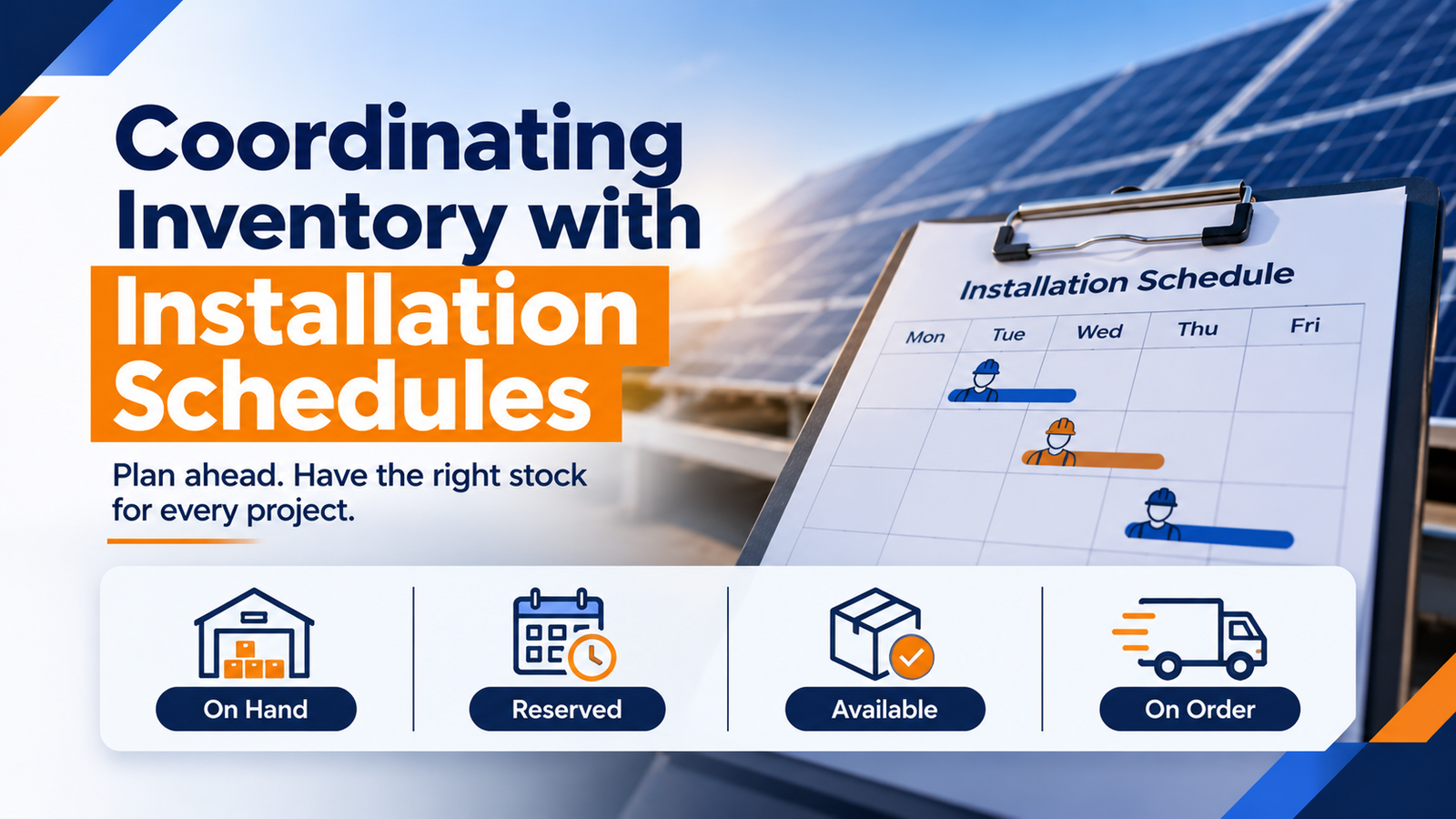
Coordinating Inventory with Installation Schedules
Solar inventory requirements are closely tied to upcoming installation projects.
Unlike a retail business that replenishes products primarily based on sales history, a solar contractor often knows which materials will be needed for scheduled installations.
This creates an opportunity to plan inventory around project demand.
A company preparing for several installations next month may need to determine whether its existing stock can support those projects before placing additional purchase orders.
However, the quantity physically sitting in the warehouse does not necessarily represent the quantity available for a new installation.
Some materials may already be committed to other projects, while additional inventory may be on order but not yet received.
Effective planning therefore requires visibility into several quantities:
- On Hand: Inventory physically available in the business’s locations.
- Reserved: Inventory already committed to existing orders or projects.
- Available: Inventory that remains available after applicable reservations.
- On Order: Inventory expected from suppliers but not yet received.
Understanding these differences helps purchasing teams avoid promising the same inventory to multiple projects or ordering unnecessary duplicates.
Complete Material Lists Reduce Last-Minute Shortages
One of the most effective ways to prepare for solar installations is to establish a standardized material list for each project type.
A residential rooftop installation, for example, may require a predictable combination of panels, mounting equipment, electrical components, and accessories.
Although exact quantities depend on the system design, a standard material list provides a starting point for preparing and checking the required inventory.
For repeatable installation packages, businesses may also use a Bill of Materials (BOM) to organize component requirements.
This approach helps installation teams identify missing materials before the project reaches the job site.
It also supports more consistent purchasing. When installation requirements are clearly defined, buyers can evaluate component availability against upcoming demand rather than ordering individual items only after shortages occur.
Standardized material planning is particularly useful for contractors handling multiple installations simultaneously.
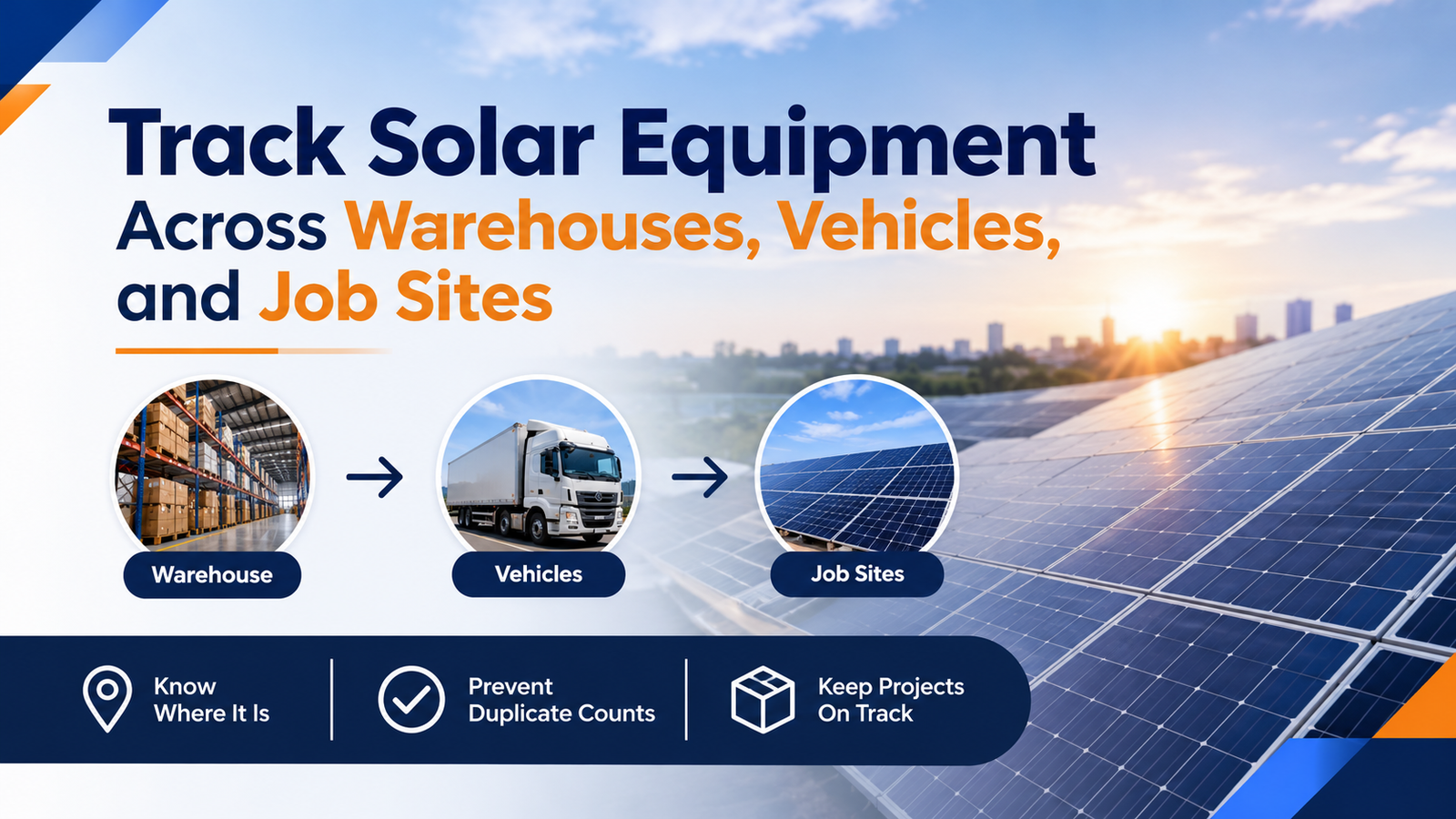
Tracking Solar Equipment Across Warehouses, Vehicles, and Job Sites
Solar installation materials rarely remain in one location.
Equipment may arrive at a central warehouse, move into temporary staging areas, be loaded onto delivery vehicles, and eventually reach an installation site.
Some materials may be returned after a project is completed, while unused components may be transferred to another location for future work.
Without accurate inventory transfers, businesses can lose visibility into where equipment is physically located.
For example, a warehouse may show 30 inverters in stock even though 12 have already been loaded for upcoming installations. If those movements are not recorded, purchasing and warehouse teams may make decisions based on inaccurate location information.
A structured inventory process should distinguish between warehouse stock, vehicle inventory, job-site inventory, and materials that have been consumed or installed.
Recording these movements helps prevent the same equipment from appearing available in multiple places and makes it easier to locate unused materials.
Barcode Scanning Improves Equipment Visibility
Manual inventory entry becomes increasingly difficult when employees handle many similar-looking components.
Solar panels may have different model numbers, power ratings, and specifications. Inverters and electrical equipment can also vary by manufacturer and configuration.
Selecting the wrong item during receiving or transferring inventory can create discrepancies that are difficult to discover later.
Barcode scanning allows warehouse employees to identify products more accurately during routine inventory activities.
For example, an employee receiving a shipment can scan the product barcode, verify the quantity, and record the inventory in the appropriate warehouse location.
The same approach can support inventory transfers, stock counts, and material preparation for installation.
Barcode workflows are particularly valuable when materials are handled by different employees across purchasing, warehousing, and field operations.
For higher-value equipment, serial number tracking may also be useful when supported by the inventory system, especially for warranty documentation and equipment identification.
Managing Purchasing and Supplier Lead Times
Solar installation schedules can be affected by supplier availability, shipping delays, and changing equipment requirements.
Panels, inverters, batteries, and specialized mounting components may have different purchasing lead times. Some products may be readily available from local distributors, while others require advance ordering.
A purchasing process based only on current stock quantities may fail to account for materials already committed to scheduled installations.
Businesses should review upcoming project requirements alongside existing inventory and outstanding purchase orders.
This helps identify which components need to be purchased, which are already on order, and which can be supplied from existing stock.
Supplier performance also matters. Tracking delivery reliability and recurring shortages can help purchasing teams make better sourcing decisions and reduce disruptions to installation schedules.
Avoiding Excess Inventory and Obsolete Equipment
While shortages can delay installations, excessive solar inventory creates its own financial risks.
Solar equipment represents a significant investment, and holding more inventory than necessary ties up working capital.
Product specifications, customer preferences, equipment compatibility, and technology can also change over time. Materials purchased for one installation configuration may not be suitable for another.
This makes inventory turnover and purchasing discipline important for solar contractors.
Regularly reviewing slow-moving equipment helps businesses identify products that are no longer being used frequently, while monitoring upcoming installation demand helps determine whether additional purchases are justified.
Smaller components should not be overlooked either. Excess mounting hardware, connectors, and accessories can accumulate across warehouses and vehicles when inventory movement is poorly controlled.
The goal is to maintain enough inventory to support scheduled installations while avoiding unnecessary stock that may remain unused for extended periods.
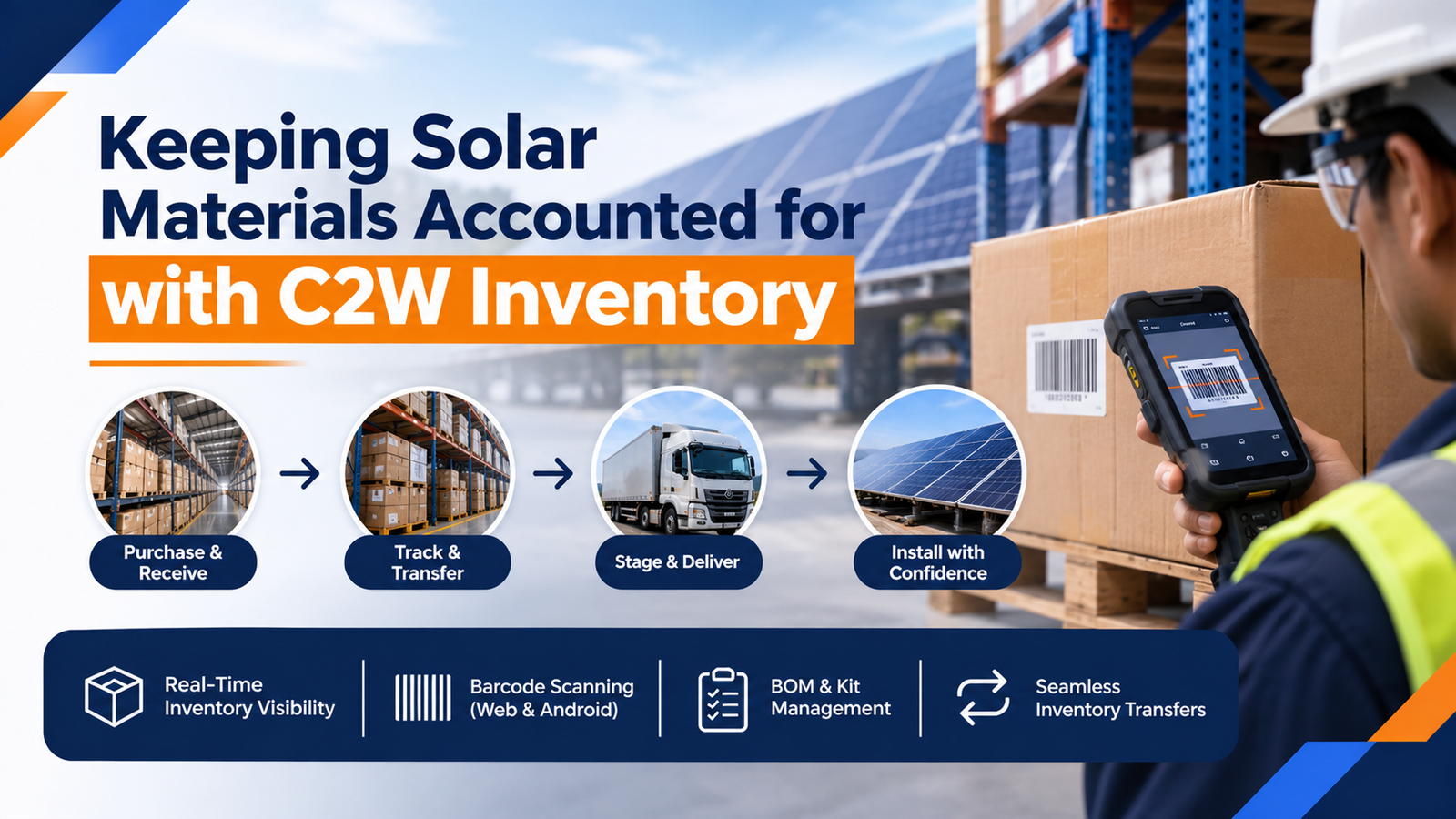
Keeping Solar Materials Accounted for with C2W Inventory
The handoff between the warehouse and an installation crew is one of the most important points in solar inventory control. Materials that were carefully received and organized can quickly become difficult to account for once they are staged, loaded, transferred, or returned.
C2W Inventory helps businesses manage these movements through connected purchasing, inventory, and warehouse workflows.
Purchase Orders provide visibility into materials being sourced from suppliers, while receiving updates inventory as equipment arrives. Warehouse teams can organize inventory across multiple locations and record transfers when materials move between storage areas, vehicles, or designated job-site locations.
For contractors preparing repeatable installation packages, C2W’s BOM and manufacturing capabilities can also support the organization of component requirements and kit-based workflows where appropriate.
Barcode scanning through the C2W Web App and Android SmartScan allows employees to work with inventory using mobile devices or compatible professional scanners such as Zebra and Honeywell. This makes it easier to record receiving, transfers, and inventory adjustments without relying on handwritten notes that must be entered later.
Inventory visibility across on-hand, reserved, and incoming quantities can also help purchasing and warehouse teams evaluate whether materials are available for upcoming work.
Rather than treating purchasing, warehouse stock, and field inventory as separate records, solar contractors can maintain a more consistent view of where their materials are and how quantities change as installations progress.
Building a More Reliable Warehouse-to-Job-Site Process
Accurate solar inventory management depends on consistent procedures across purchasing, receiving, storage, and installation preparation.
Before materials leave the warehouse, teams should verify that the required components are available and correctly identified. Transfers should be recorded when equipment moves to vehicles or job sites, and unused materials should be accounted for when they return.
Regular inventory counts can also help identify discrepancies before they affect upcoming installations.
For contractors managing multiple projects, these practices reduce uncertainty and make it easier to coordinate material availability with installation schedules.
Solar projects depend on many interconnected components, and successful installation preparation requires more than keeping panels in stock. Maintaining accurate inventory across the entire warehouse-to-job-site process helps contractors reduce avoidable delays, control material costs, and keep installation crews focused on completing their work.
Frequently Asked Questions
Q: What is solar inventory management?
A: Solar inventory management is the process of tracking solar panels, inverters, mounting equipment, electrical components, and other installation materials throughout purchasing, storage, transportation, and installation. It helps contractors maintain accurate stock quantities and ensure that materials are available for scheduled projects.
Q: What inventory should a solar installation company track?
A: Solar installers should track major equipment such as panels, inverters, and batteries, along with mounting hardware, wiring, connectors, electrical components, and other installation supplies. Inventory should be organized by item and location, with additional identification such as serial numbers when necessary and supported.
Q: How can solar contractors prevent missing materials at job sites?
A: Contractors can reduce missing materials by preparing standardized project material lists, verifying inventory before loading, recording transfers between warehouses and job sites, using barcode scanning, and reconciling unused materials after installation.
Q: Why is inventory software important for solar installation companies?
A: Inventory software helps solar contractors maintain visibility into stock quantities, supplier orders, material movements, and inventory across multiple locations. Accurate information can reduce purchasing mistakes, prevent shortages, and improve coordination between warehouse employees and installation crews.